How AI Transforms and Supports Landscape Architecture?
- Gülsevin Koçak
- Nov 19
- 12 min read

Artificial intelligence is opening a new chapter in landscape architecture. It brings together data, ecology, and design intelligence to transform the way outdoor environments are imagined and developed. What once depended on field observation and intuition can now be enriched with real time analysis and predictive modeling, giving designers a deeper understanding of the natural systems they work with.
Through advanced tools that interpret soil conditions, vegetation patterns, hydrology, and climate data, AI turns complex environmental information into clear insight. This allows landscape architects to create greener, smarter, and more resilient spaces where creativity is strengthened, resources are used more efficiently, and sustainability becomes a measurable reality.
In the following sections, you will explore how AI enhances site analysis, supports sustainable design decisions, improves landscape management, and enriches the creative process in shaping resilient outdoor environments.
What is Landscape Architecture?
Landscape architecture is the design, planning, and management of outdoor environments to create functional, aesthetically pleasing, and ecologically responsible spaces.
It integrates natural elements such as landforms, plants, and water with built features to support human activity, environmental health, and cultural meaning.
The Intersection of AI and Landscape Architecture
The growing influence of AI in landscape architecture is changing how designers plan, create, and manage outdoor environments. What once depended on manual drawing and field observation is now supported by artificial intelligence in architectural design, bringing deeper insights and greater precision to every stage of a project.
Modern landscape architects are using AI to combine creativity with data. This technology helps them analyze environmental factors, simulate natural systems, and build landscapes that are more sustainable and adaptive to change.
Key ways AI supports landscape architecture include:
Smart landscape management that improves irrigation, lighting, and maintenance efficiency.
AI-driven site analysis that studies soil, vegetation, and climate data for better planning.
Machine learning tools that identify patterns and suggest plant selections for local ecosystems.
Generative design techniques that produce innovative, sustainable design alternatives.
By integrating artificial intelligence in design, professionals can make more informed choices, reduce waste, and enhance both functionality and beauty in the built environment. AI is becoming a valuable partner that amplifies human creativity and supports the future of sustainable landscape design.
The Evolution of Landscape Architecture Through Technology
From Manual Drafting to Data-Driven Design
Landscape architecture has moved far beyond sketching and traditional design boards. The introduction of data-driven landscape architecture has transformed how professionals approach planning, visualization, and long-term management. Instead of relying only on aesthetic intuition, designers now use AI-powered tools to interpret environmental data and create more functional, sustainable spaces.
Machine learning for landscape planning plays a key role in this shift. It helps analyze vast datasets such as topography, soil conditions, and climate patterns to make informed design choices. Through predictive algorithms, architects can test multiple design outcomes, reducing the margin of error and saving both time and resources.
Key transformations include:
Faster and more precise environmental data interpretation.
Predictive modeling for long-term ecosystem performance.
Efficient material and resource planning using AI analytics.
This transition from manual drafting to AI-enhanced design processes enables architects to balance creativity with technical precision, creating landscapes that respond intelligently to changing environmental needs.
The Rise of Computational and Generative Design
The concept of generative design in landscape architecture is redefining creativity in the field. Using algorithms and computational tools, designers can generate multiple design variations based on specific parameters such as terrain, climate, and sustainability goals. This process encourages experimentation and supports decision-making through real-time performance feedback.
AI-driven design tools allow architects to explore endless possibilities, automatically adjusting forms and layouts for optimal functionality and aesthetics. They help identify solutions that balance ecological health, cost efficiency, and user experience.
Some benefits of adopting computational and generative design include:
Creating diverse and innovative design alternatives quickly.
Reducing human bias by testing data-based design options.
Improving sustainability outcomes through AI simulation models.
Supporting collaboration between human creativity and artificial intelligence.
Through these innovations, AI in landscape architecture is not replacing designers but empowering them to build smarter, more adaptive environments that integrate technology, nature, and human experience.
How AI Supports Landscape Design and Planning?
AI-Driven Site Analysis and Environmental Data Processing

Modern landscape architects increasingly rely on AI-driven site analysis to gain a deeper understanding of complex environmental conditions. By combining computer vision and predictive modeling, AI systems can evaluate site elements such as topography, soil composition, vegetation density, and water flow patterns with remarkable accuracy. This level of insight allows architects to make more informed decisions before design even begins.
Through environmental data analysis with AI, professionals can interpret climate trends, analyze ecological risks, and identify the most suitable design strategies for sustainability. These tools go beyond static maps, offering dynamic simulations that show how a site will respond to environmental stressors like erosion, flooding, or drought.
Practical uses include:
Automated image recognition for terrain and vegetation classification.
Predictive analysis to forecast long-term site changes.
Integration of weather and soil data into the design process.
The result is a planning process that is not only faster but also far more precise, ensuring that each project aligns with environmental performance goals and long-term resilience.
Ecosystem Simulation and Predictive Modeling
Ecosystem simulation with AI allows landscape architects to visualize and test natural processes digitally before implementing them in real life. Using algorithms that replicate the behavior of vegetation, water flow, and wildlife habitats, designers can anticipate how landscapes will evolve over time. This predictive capability helps minimize ecological disruption and promotes harmony between design and nature.
A key technology enabling this is the concept of digital twins in landscape architecture. These are virtual replicas of real-world environments that let designers experiment with scenarios such as seasonal changes, water circulation, and plant growth under different climate conditions.
Benefits of ecosystem simulation include:
Testing the long-term effects of planting and irrigation strategies.
Evaluating the ecological impact of design choices.
Enhancing collaboration between designers, engineers, and environmental scientists.
By leveraging AI-driven predictive modeling, architects can design landscapes that are both ecologically balanced and adaptive to future environmental changes.
Smart Landscape Management Systems
The rise of smart landscape management is revolutionizing how landscapes are monitored and maintained. With AI-based irrigation and water management systems, sensors and algorithms work together to track soil moisture, detect leaks, and optimize water usage automatically. This not only reduces waste but also ensures that plants receive the right amount of water at the right time.
Climate-adaptive design using AI extends these capabilities by responding in real time to environmental data. For instance, systems can adjust lighting, drainage, or maintenance schedules based on weather forecasts or air quality readings.
Key advantages include:
Significant reductions in water and energy consumption.
Lower maintenance costs through automation and predictive repair alerts.
Enhanced resilience against climate fluctuations.
By integrating AI in landscape architecture, professionals are transforming maintenance into an intelligent, responsive process that promotes sustainability, efficiency, and long-term environmental health.
Tools and Technologies Empowering Landscape Architects
AI Tools for Landscape Architecture
The integration of technology into landscape architecture has given rise to a new generation of intelligent tools that improve every stage of the design process. Today’s AI tools for landscape architects are capable of analyzing environmental data, generating design alternatives, and optimizing material selection for sustainability and cost efficiency.
Common tools and platforms used by landscape professionals include:
Generative design software that explores multiple layout options based on climate and topography.
Predictive modeling platforms that simulate how landscapes will respond to environmental change.
3D visualization and rendering programs enhanced with AI for realistic modeling.
GIS and AI integration systems that connect geospatial data with machine learning algorithms to support data-driven landscape design.
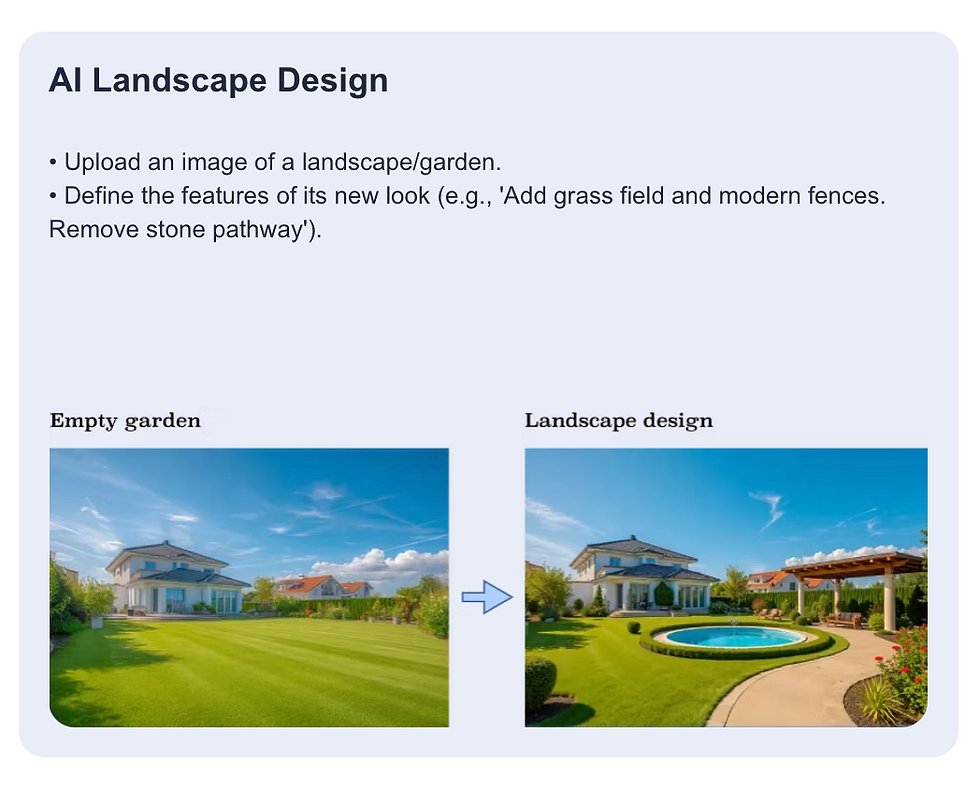
Among these technologies, ArchiVinci’s Landscape Module stands out as a comprehensive AI-powered platform. It enables designers to analyze terrain, vegetation, and microclimate conditions while visualizing real-time environmental interactions. By using the Landscape AI module, professionals can evaluate terrain performance, test design alternatives, and make informed decisions that align with sustainability goals.
By combining AI in landscape architecture with geospatial intelligence, and tools like Archivinci, landscape architects can create smarter, more resilient, and ecologically balanced environments.
Drone and Sensor Integration
The combination of drone and AI integration has revolutionized how landscape architects map and monitor outdoor environments. Equipped with cameras and sensors, drones collect high-resolution imagery that is processed using computer vision in landscape architecture. This technology automatically identifies terrain features, vegetation types, and erosion patterns, providing accurate data that supports planning and conservation efforts.
In addition, AI-driven site analysis powered by drone data allows designers to detect subtle landscape variations that are often missed by traditional surveying. Sensors placed on-site can continuously measure soil moisture, light exposure, and temperature, feeding data back into AI systems for real-time analysis.
Platforms like ArchiVinci’s Landscape Design module further enhance this process by integrating drone and sensor data into a single visualization and analytics dashboard. Designers can use these insights to monitor environmental changes, predict performance outcomes, and maintain landscapes more efficiently.
Key benefits include:
Faster and more precise mapping of large or hard-to-reach areas.
Continuous environmental monitoring for early detection of changes or risks.
Enhanced collaboration between design teams through cloud-based data sharing.
By integrating drones, sensors, artificial intelligence, and platforms such as ArchiVinci’s Landscape module, landscape architects can design adaptive, sustainable spaces that respond intelligently to both human and ecological needs.
Sustainability and Resilience in Landscape Design
Sustainable Landscape Design with AI
The use of AI in landscape architecture has become essential for creating environmentally responsible and energy-efficient spaces. Sustainable landscape design with AI allows architects to balance ecological health, human comfort, and long-term performance through intelligent data analysis and predictive modeling.
By processing large environmental datasets, AI helps identify design strategies that minimize waste, reduce carbon emissions, and improve biodiversity. For instance, climate-adaptive AI models can analyze temperature, rainfall, and sunlight patterns to determine the most efficient planting layouts or water management systems.
Examples of how AI enhances sustainability include:
Optimizing irrigation schedules to reduce water use and energy consumption.
Selecting plant species suited to local climate conditions through predictive algorithms.
Designing shading and airflow systems that enhance comfort while lowering energy demand.
Using machine learning for landscape planning to anticipate future ecological changes.
These innovations promote resilience in landscape design, ensuring that spaces remain functional and beautiful even under the pressures of climate change and urban growth.
Data-Driven Strategies for Green Spaces
Data-driven decision-making has become a cornerstone of modern environmental design. By using AI-driven analysis, landscape architects can monitor performance metrics such as air quality, soil health, and water efficiency to guide ongoing improvements. This data-centric approach turns every green space into a living system that adapts and evolves over time.
Key strategies include:
Collecting and analyzing sensor data to inform maintenance and planting schedules.
Integrating predictive modeling to forecast ecological performance.
Using GIS and AI integration to evaluate spatial relationships and optimize resource distribution.
Through these data-driven strategies, architects can create landscapes that are not only sustainable but also measurable in their ecological impact. The result is a smarter, more responsive design process that supports both people and the planet.
Human-AI Collaboration and Ethical Considerations
The Role of Human Creativity in AI Landscape Design
While AI in landscape architecture brings remarkable analytical power, the heart of design still lies in human creativity. Human-AI collaboration enhances the design process by combining intuitive, artistic vision with data-driven insights. AI can quickly process complex environmental data, but it is the designer who interprets that data, making creative and ethical choices that reflect culture, aesthetics, and human experience.
In practice, this collaboration allows designers to:
Explore innovative solutions through generative design in landscape architecture.
Use AI suggestions as inspiration rather than instruction.
Balance functionality, emotion, and environmental responsibility.
Save time on repetitive tasks and dedicate more energy to conceptual exploration.
By treating AI as a creative partner, landscape architects can expand their design horizons, producing landscapes that are not only efficient but also emotionally engaging and contextually meaningful.
Challenges and Opportunities of AI in Landscape Architecture
The integration of AI in landscape architecture presents both exciting possibilities and important challenges. On one hand, artificial intelligence in design offers advanced tools for analysis, sustainability, and efficiency. On the other, it raises concerns about dependency, creativity loss, and the accessibility of technology.
Opportunities
Improved accuracy and predictive capability through machine learning for landscape planning.
Enhanced sustainability and resource management.
Greater design diversity using AI-driven generative design tools.
Time savings and reduced costs for clients and teams.
Challenges
High implementation costs and technical complexity.
The risk of over-reliance on algorithmic outputs.
Potential reduction of human intuition in design decisions.
Limited access to advanced AI tools for smaller firms or developing regions.
Navigating these challenges requires thoughtful adoption, where designers remain in control of creative intent while leveraging technology to enhance precision and environmental performance.
Ethics, Bias, and Transparency
As AI in design and planning becomes more widespread, ethical considerations are increasingly important. Algorithms are only as unbiased as the data they are trained on, which means that poor data quality or lack of diversity can lead to design outcomes that unintentionally favor certain regions, climates, or communities.
To ensure fairness and transparency, landscape architects must:
Use diverse and inclusive datasets when applying AI-driven site analysis.
Clearly document the assumptions and limitations of AI-generated models.
Maintain human oversight throughout the design process to ensure ethical outcomes.
Advocate for open-source AI tools that prioritize transparency and accountability.
Ethical design requires not just technological skill but moral awareness. By prioritizing transparency and responsible AI practices, designers can build landscapes that reflect equity, sustainability, and long-term social value.
The Future of Landscape Architecture in the Age of AI
AI-Driven Innovations and Emerging Trends
The future of AI in landscape architecture promises an even deeper integration of technology into design, visualization, and environmental management. New tools powered by generative AI are already transforming how professionals conceptualize and present their ideas. These technologies enable real-time landscape visualization, producing lifelike renderings and simulations that help clients and communities better understand design proposals.
Emerging innovations shaping the field include:
Generative AI for landscape visualization that creates multiple design concepts instantly.
Digital twins in landscape architecture that model ecosystems for long-term monitoring.
Predictive modeling tools that forecast ecological and climate-related impacts.
Augmented reality (AR) and virtual reality (VR) for immersive design presentations.
AI-driven sustainability platforms that evaluate energy use, carbon footprint, and biodiversity potential.
These advancements are moving the profession toward a more adaptive and intelligent design approach where creativity, performance, and sustainability are seamlessly connected. The collaboration between human designers and AI systems will continue to define how we plan and shape our landscapes for future generations.
Preparing the Next Generation of Landscape Architects
As technology becomes central to environmental design, the next generation of landscape architects must develop a balance of creative thinking, ecological awareness, and technical expertise. The future of AI-powered landscape design will rely on professionals who understand both artistic vision and computational intelligence.
Essential skills for tomorrow’s landscape architects include:
Data literacy to interpret and apply environmental datasets effectively.
Proficiency with AI-driven design tools and machine learning platforms.
Understanding of GIS and AI integration for spatial and ecological analysis.
Strong collaboration and ethical awareness in working with AI systems.
Creative adaptability to use technology as a partner, not a replacement.
Educational programs and professional training are beginning to reflect this shift, emphasizing cross-disciplinary learning that merges design, data science, and environmental studies. By mastering these skills, future landscape architects will be equipped to lead the transformation toward sustainable, intelligent, and human-centered landscapes.
Redefining the Landscape with Artificial Intelligence
The rise of AI in landscape architecture is transforming how we design, manage, and sustain outdoor environments. By combining creativity with advanced technology, landscape architects can now shape spaces that are innovative, efficient, and ecologically balanced. Artificial intelligence enhances every phase of the process, from AI-driven site analysis and generative design to smart landscape management and climate-adaptive planning.
Through innovation, sustainability, and smart design, AI helps professionals create landscapes that adapt to environmental change while improving resource efficiency and ecological health. It enables a deeper understanding of site conditions, optimizes plant and material selection, and promotes long-term environmental resilience.
Platforms like ArchiVinci are leading this transformation with their AI Landscape Design module, providing designers with intelligent tools for analysis, visualization, and simulation. By integrating AI-driven technology into the creative process, ArchiVinci empowers landscape architects to plan more sustainable and data-informed projects that align with both human and natural systems.
As the profession continues to evolve, embracing AI-powered tools such as Archivinci’s Landscape Module will be key to advancing the future of environmental design. Designers who adopt these innovations will help build landscapes that are intelligent, adaptive, and truly connected to the world around us.
Frequently Asked Questions (FAQ)
How does AI help reduce project costs in landscape architecture?
AI optimizes planning by analyzing terrain, materials, and climate data early in the design process. This minimizes trial-and-error, prevents overuse of resources, and helps architects select the most cost-efficient solutions. Platforms like ArchiVinci’s Landscape module also automate repetitive tasks such as data visualization and site analysis, which saves both time and labor.
Can AI tools replace human designers in landscape architecture?
No, AI cannot replace human designers. While AI can process data and generate design alternatives, human creativity, empathy, and contextual understanding remain essential. The best results come from human-AI collaboration, where technology supports designers rather than replaces them.
What kind of data does AI use in landscape projects?
AI systems rely on environmental and spatial data such as soil type, vegetation density, sunlight exposure, topography, and climate history. Some tools also use real-time sensor data to track changes over time. This data helps improve accuracy in AI-driven site analysis and long-term maintenance planning.
How can AI support sustainability goals in urban landscapes?
AI supports sustainability by predicting the environmental impact of design choices. It helps identify the most energy-efficient materials, optimize irrigation schedules, and reduce waste. Using predictive modeling, AI can also forecast how green spaces will evolve, ensuring long-term ecological balance in urban environments.
What is the role of drones and sensors in AI landscape design?
Drones and sensors provide high-quality spatial data that feed directly into AI platforms. This allows for precise mapping, vegetation tracking, and erosion detection. When integrated with systems like ArchiVinci’s Landscape module, the data can be visualized and analyzed to improve environmental performance and maintenance efficiency.
How can new designers start learning AI for landscape architecture?
Aspiring professionals can begin by learning GIS mapping, machine learning basics, and data visualization. Many software platforms, including Archivinci, offer user-friendly interfaces that make it easier for beginners to understand how AI can support design workflows. Continuous learning through online courses and hands-on projects is key to developing these skills.


